Bokeh - an anglicized version of the Japanese word 'Boke' altered to aid correct English pronunciation. 'Boke' means fuzzy, simple, or, as an insult, senile. Boke, and laterly Bokeh, have been appropriated by photographers to refer to the out of focus elements of a photograph. See wikipedia http://en.wikipedia.org/wiki/Bokeh for a detailed explanation.
Photographers tend to favour bokeh that mimics the appearance of out-of-focus elements in our own vision. Ironically, because of the rapid manner in which our own eyes quickly refocus it is normally only possible to 'see' human bokeh in extreme close-up, or if you are short or longsighted.
Bokeh can be used to dramatic effect to isolate the subject of a photograph from the background (and/or foreground) - so called 'selective focus'. At least it used to be, because with modern digital cameras it is harder to actually render elements of the scene out-of-focus. Two factors make this so -
1. Many, in fact most, digital cameras have imaging sensors that have smaller areas than their film predecessors.
2. Many lenses for digital cameras have smaller maximum apertures than their film lens predecessors.
Now the depth of field, that is the volume in front of the lens in which objects appear to be within acceptable focus, is dependent on three things: the range to the subject in focus, the focal length of the lens, and the lens aperture.
Range affects depth of field in a reciprocal manner - the closer the subject is to the lens the shallower the depth of field for any given aperture.
The focal length of the lens determines the angle of coverage of the lens - a long focal length covers a narrower angle than a shorter one.
Aperture is normally perceived as the photographer's tool for controlling depth of field - a small aperture yields a larger depth of field, and a large one the reverse. Beyond a certain point a decreasing aperture will actually decrease apparent sharpness, but this is because the effects of diffraction start to dominate the recorded signal.
The aperture, of course, is also one of the three primary means for governing image exposure, the others being shutter speed and film, or its electronic equivalent, sensitivity (I am neglecting filters for the moment).
Now let us say we are going to shoot a full length portrait at typical distance from the subject say 10ft/3m. We are going to use a conventional 35 mm film camera with a 50 mm lens. We want sufficient depth of field that our subject, striking a dramatic pose, is all in focus, but that the garden behind them is rendered in dramatic blur. So we chose an wide-ish aperture of f/4.0. Let us use a circle of confusion criterion, COC=1/(1300/d), where d is image diagonal in mm, to determine acceptable focus in the final print. Off to do some sums. At this distance, with these settings, our depth of field would extend from approximately 2.5m to 3.6m in front of the camera.
Let us switch to a digital camera, specifically the Nikon D200 (my digital camera). In order to match the angle of view of our film camera we must use a focal length of 33mm. This is because the DX format sensor of the D200 is smaller than a 35mm film frame. With all other conditions being the same the depth of field now extends from approximately 2.4m to 4m. In other words our depth of field has extended by 0.5m. Or, to put it another way, to match our 35mm camera in depth of field we would have to open up to f/2.8. Which is okay except that many of the DX format lenses made for the D200 and its ilk don't go as wide as f/2.8.
Now couple to this to the fact that a smaller sensor means a smaller pentaprism and a smaller viewfinder view and you can see that DX format digital cameras and similar from Canon, Olympus etc. have some drawbacks. They have some benefits also - the 'magnifier' effect on the focal length means sports and wildlife photographers are happy.
For me the D200 is a mixed bag. It has a grid in the viewfinder, but I struggle to find and maintain horizons in the titchy viewfinder. Which means I am frequently rotating and cropping post capture. Its pictures are good - very good - the colours appear true and there are plenty of options to tune them. Resolution matches all but the very, very finest 35mm film. Exposure noise (grain) at the equivalent of ISO1600 is no worse than a 1600ASA print film in the mid-1980s. Build quality is close to my old F5. And I love digital - I take more pictures and I can check them in the field.
So what would be my perfect camera? It would be digital, but with a bigger viewfinder (maybe even an electronic level?). Its high ISO performance could match late 90's film (or even better it). And build quality would equal (or better) my F5. And I'd still like to be able to use my 18-200 VR zoom when I want to travel light.
Nikon, I'm gonna cite you in the inevitable divorce papers.
Sell your photos online
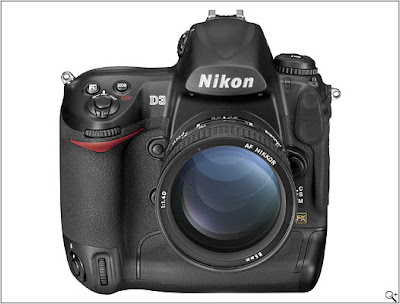
 The Nikon D4 is almost upon us. A thing of beauty to be sure. Probably too rich for my blood for a while, but very likely to be in my kit bag by this time next year. Image is of Nikon non-functioning engineering model - ignore the shiny finish.
